Is My Cat in Pain?
Learn What to Look For.
Cats can show subtle signs of discomfort. Compare five facial features with changes in your cat’s daily routine, save a summary, and share concerns with your veterinarian.
Observe five facial features described by the FGS.
Safety questions and practical next steps.
A simple summary to bring to your vet.
What are the five Feline Grimace Scale signs?
The Feline Grimace Scale (FGS) was developed at the Université de Montréal and published in Scientific Reports in 2019 to score acute pain from a cat’s face. Each of five signs is scored 0, 1 or 2, for a total out of 10. The FGS team advises owners to contact a veterinarian when the total is 4 or more.
| Sign | 0 · absent | 1 · moderate or unsure | 2 · marked |
|---|---|---|---|
| Ears | Ears facing forward | Ears slightly pulled apart | Ears flattened and rotated outwards |
| Eyes (orbital tightening) | Eyes opened | Eyes partially opened | Squinted eyes |
| Muzzle | Muzzle relaxed (round shape) | Muzzle mildly tense | Muzzle tense (elliptical shape) |
| Whiskers | Whiskers loose and curved | Whiskers slightly curved or straight | Whiskers straight and moving forward |
| Head | Head above the shoulder line | Head aligned with the shoulder line | Head below the shoulder line or tilted down |
Score a cat that is awake and resting, not eating, grooming or asleep. This site’s AI scoring is an independent observation aid. It is not an official or clinically validated automated FGS assessment.
Behaviour signs of pain in cats
A relaxed face does not rule out pain. A panel of cat pain experts reached an expert consensus on behavioural signs of pain in cats (PLOS ONE, 2016) that includes changes like these:
- Eating less, or walking away from food after a few bites
- Hiding, or less interest in people and play
- Jumping less often or less high, or hesitating before stairs
- Grooming less (a matted or greasy coat), or licking one spot over and over
- Peeing or pooping outside the litter box
- Sitting hunched with the head held low
- Limping, or stiffness after rest
- Flinching, hissing or growling when one area is touched
Write down when each change began and how often it happens, and bring that record and a photo to your veterinarian. A senior cat that stops eating needs a vet sooner rather than later.
Is my senior cat in pain? Signs of arthritis
Arthritis is common in older cats and easy to miss, because cats rarely limp. In a study of 100 cats older than 12, 90% had joint changes on X-rays. The Grimace Scale is made for acute pain, so for long-term pain like this, watch for changes in how your cat moves:
- Jumps onto lower surfaces, or uses a chair as a step
- Is stiff after sleeping, or walks more slowly on stairs
- Grooms less, especially along the lower back
- Has overgrown claws because scratching has become uncomfortable
- Misses the litter box, or goes next to a high-sided box
- Sleeps more and plays less
Small changes at home can help while you talk to your vet: a ramp or steps to favourite spots, and a litter box with a low entry. More in our senior cat care guide.
Never give your cat human painkillers
Paracetamol (acetaminophen) damages cats’ red blood cells and can be fatal. Ibuprofen and aspirin can cause stomach ulcers and kidney damage (Villar et al., ASPCA Animal Poison Control Center). Only give pain medication your veterinarian has prescribed for your cat.
Save the five-sign cards
One card per Feline Grimace Scale sign: the relaxed look, the pain sign and the sources. Save them to your phone, send them to a cat sitter, or share them with another cat owner. The wording follows the FGS team’s descriptions.
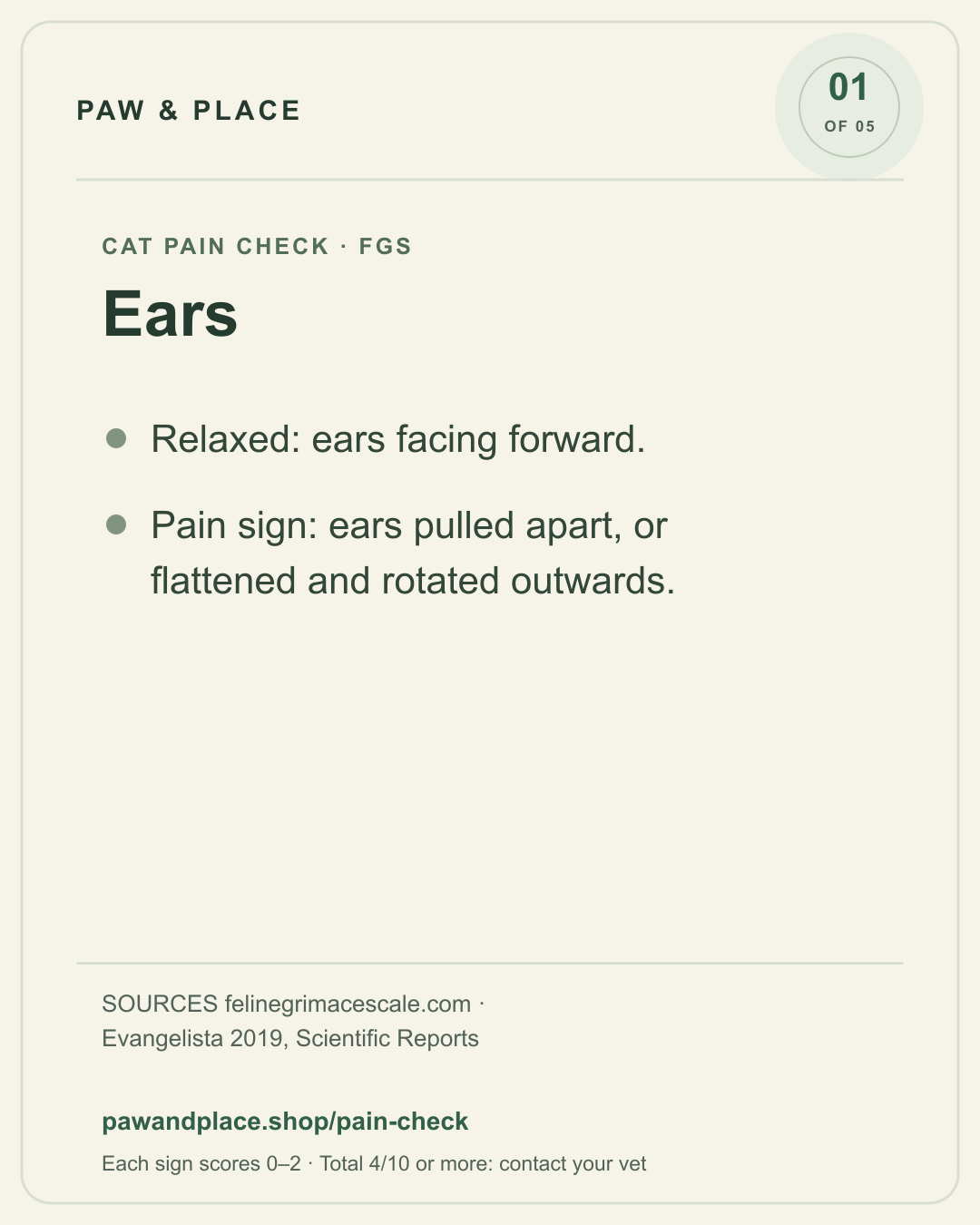
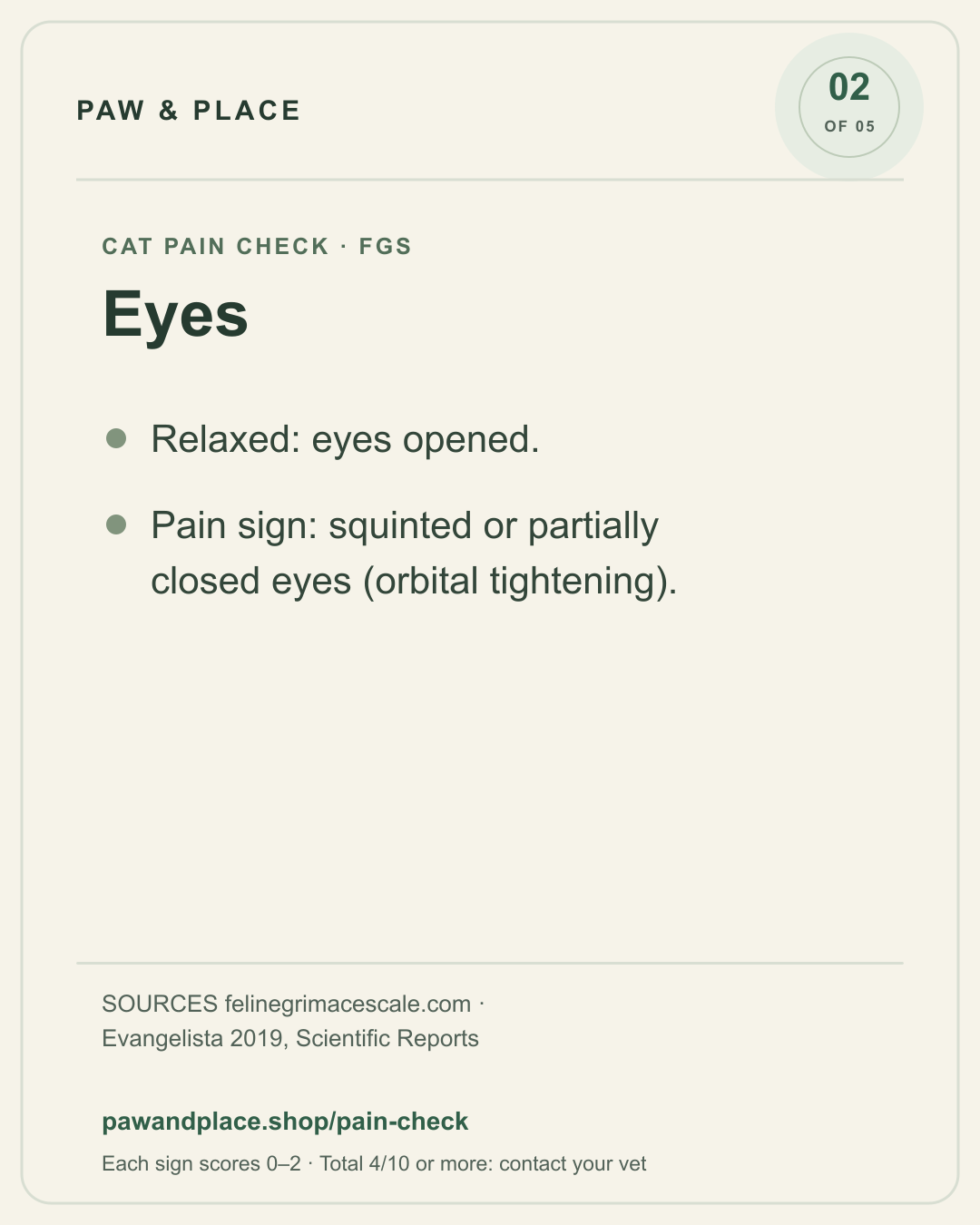
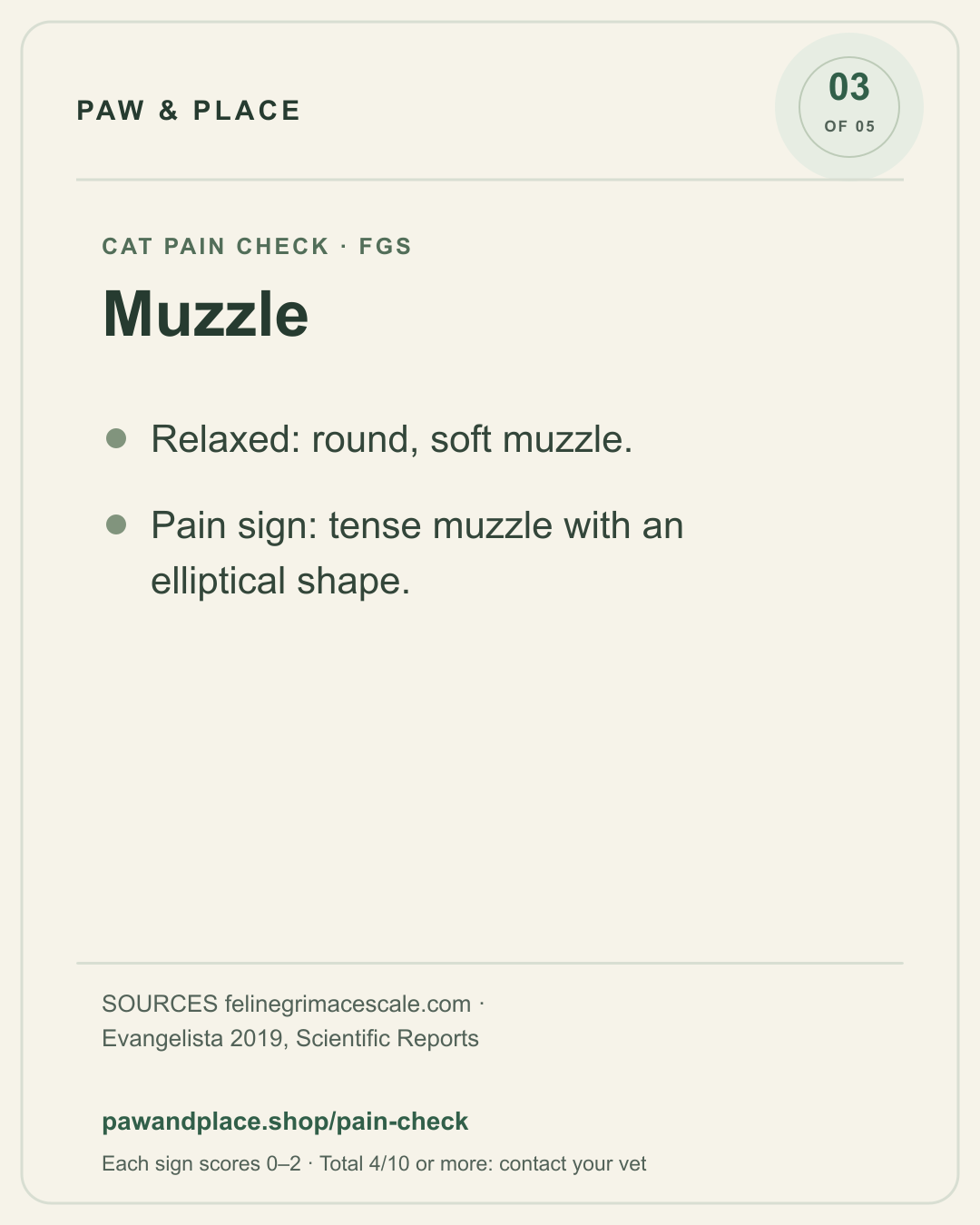
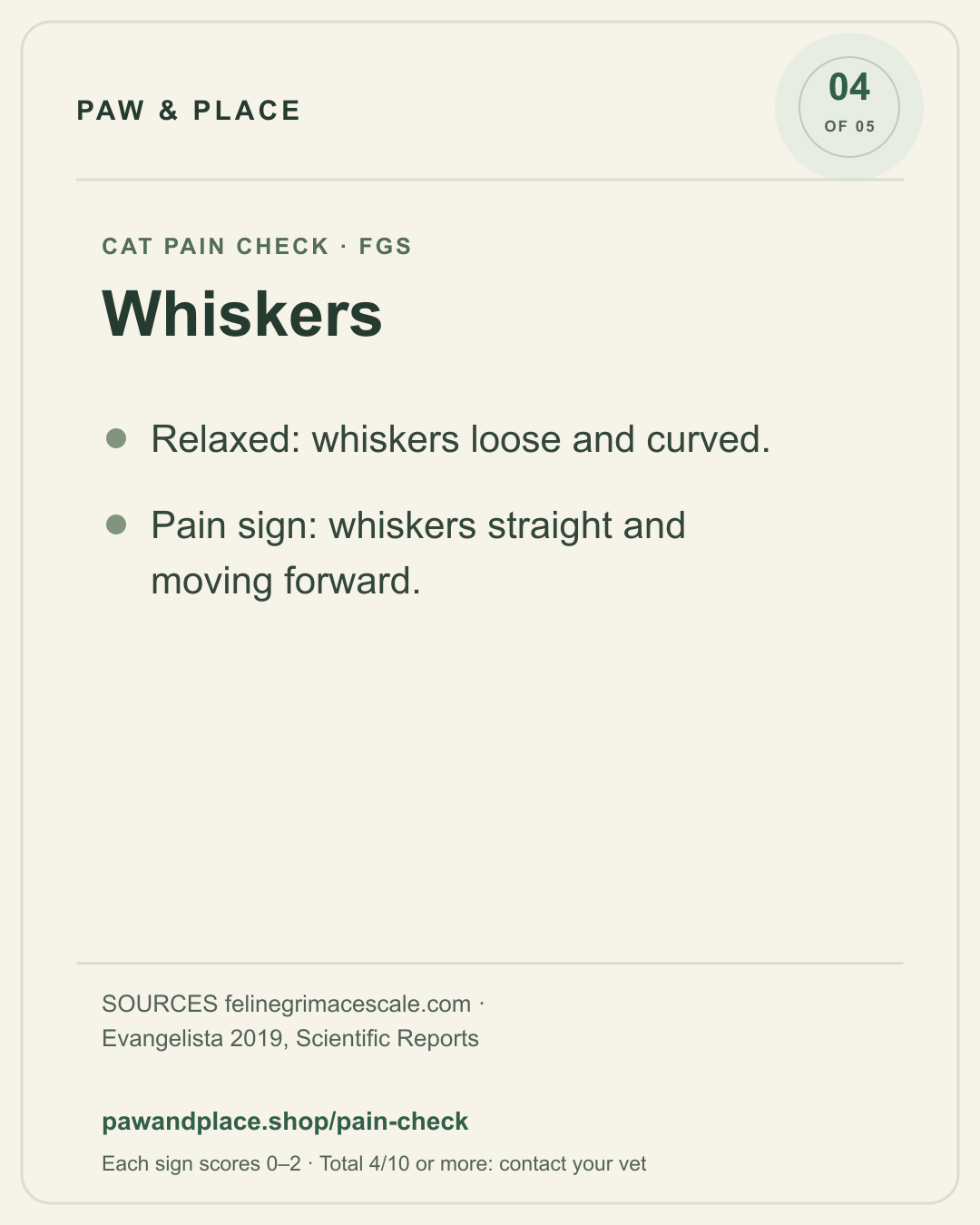
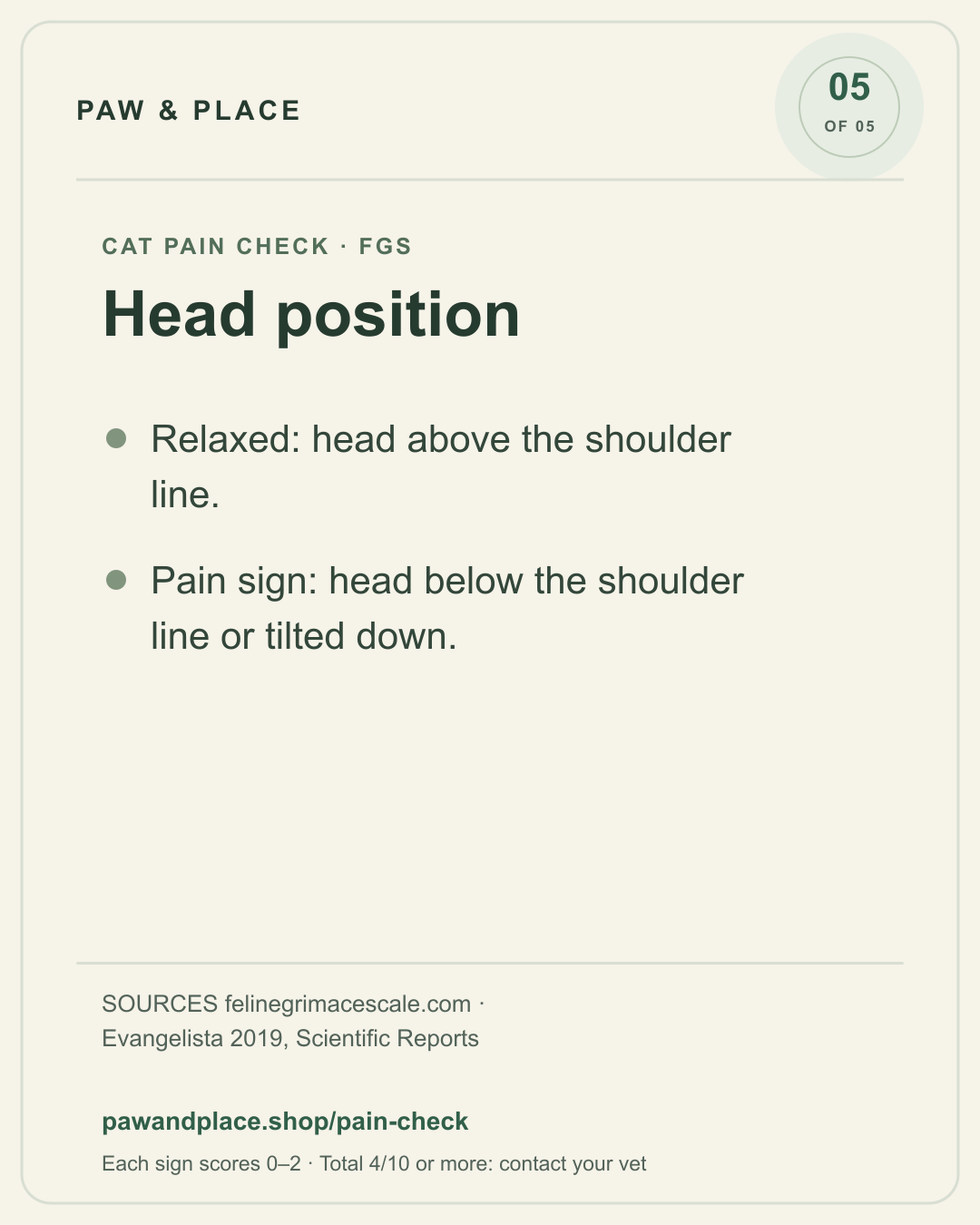
General information only, not a diagnosis. Each sign scores 0–2; contact a veterinarian when the total is 4/10 or more.
Cat Pain Check FAQ
How can I tell if my cat is in pain?
Look at two things. First, the face: ears pulled apart or flattened, squinted eyes, a tense muzzle, straight whiskers pushed forward and a head held below the shoulders are the five Feline Grimace Scale signs. Second, daily behaviour: eating less, hiding, jumping less, grooming less, or avoiding the litter box. Note when a change started and tell your vet.
What is the Feline Grimace Scale?
The Feline Grimace Scale (FGS) is a pain score developed and validated at the Université de Montréal and published in Scientific Reports in 2019. It rates five facial action units from 0 to 2, for a total out of 10. A total of 4 or more is the published cut-off at which a veterinarian should consider pain relief.
Is this an “is my cat in pain” quiz or a diagnosis?
It is a free screening aid. It records photo observations and your answers; it cannot diagnose pain or its cause.
Does a low facial score rule out pain?
No. FGS was developed for acute pain, not chronic conditions such as osteoarthritis. Behavior changes still deserve veterinary attention.
Is my senior cat in pain or just getting old?
Sleeping more, jumping less and grooming less are often put down to age, but they are also common signs of arthritis pain. In one study of 100 cats older than 12, 90% had joint changes on X-rays. A vet can examine your cat and discuss treatment.
Can I give my cat ibuprofen or paracetamol for pain?
No. Paracetamol (acetaminophen) damages cats’ red blood cells and can be fatal, and ibuprofen and aspirin can cause stomach ulcers and kidney damage. Only give pain medication that your veterinarian has prescribed for your cat.
What photo should I use?
Use one awake cat at rest, facing the camera, with ears, eyes, muzzle, and whiskers visible. Wait until eating, grooming, or sleep has ended.
When should I contact a veterinarian?
Contact your veterinarian if a complete FGS score is 4/10 or higher, or if your cat’s behavior or health has changed and you are concerned. The tool checks emergency signs before photo analysis.
Are the 48 numbered photo points measured landmarks?
No. The generated overlay is illustrative. The five editable facial scores and your behavior answers are displayed separately.
Sources: Feline Grimace Scale scoring guide, FGS FAQ, Evangelista et al. 2019, Merola & Mills 2016, Hardie et al. 2002, Villar et al. 1998 and FelineVMA pain guidance. Paw & Place is not affiliated with the FGS research group. Last updated 12 November 2026.

