PAW & PLACE · PET CARE
Your Cat Is Suddenly Drinking a Lot of Water. Here's Why That Matters
Independent general education based on cited veterinary and animal-care sources. This is not an individual diagnosis or treatment plan; ask your veterinarian to adapt care to your pet. It is not an official AAHA guideline.
Have the clumps in the litter box been getting bigger lately? Are you topping up the water bowl more often than you used to?
A lot of owners take this as a good sign. The cat is eating, the cat is drinking, so the cat must be fine. In an older cat, though, a noticeable increase in thirst deserves attention. Kidney disease is one possible cause, but diabetes, hyperthyroidism, and other problems can look similar.
Chronic kidney disease, or CKD, is one of the most common diagnoses in older cats. It becomes more common with age, but there is no single percentage that applies to every group of cats. Estimates depend on the cats being studied and how early kidney changes are detected.
The encouraging part is that many cats with CKD can be managed for a long time. Catching changes early gives you and your vet more information to work with. This article walks through the signs, how the disease progresses, what you can monitor at home, and when to get help. Near the end, there is also a section on what you can do while your cat is still young.
Sources: Cornell Feline Health Center: Chronic Kidney Disease; 2026 iCatCare CKD guidelines.
Signs worth noticing, even when your cat seems well
The kidneys do two important jobs. They filter waste out of the blood, and they concentrate urine so the body can hold on to water.
When kidney function starts to slip, a cat may lose some ability to concentrate urine. The urine becomes more dilute, so the cat pees more and drinks more to replace the lost water. This can happen before creatinine, one of the routine blood markers, rises outside the laboratory's reference range.
However, early CKD can also cause no obvious signs at all. A cat can seem well at home and still have changes on blood or urine testing. Home observations and veterinary screening work together; neither replaces the other.
Five changes are worth recording:
- Larger urine clumps or more urine overall. Clumps may be noticeably bigger than your cat's usual pattern. Litter type and cleaning frequency affect their appearance, so compare like with like. Frequent attempts that produce only tiny amounts are a different problem and may be an emergency.
- Drinking more water. The bowl empties faster, or your cat starts visiting the tap more often. A switch from wet to dry food can change bowl drinking too, so note any food changes.
- Unintended weight loss. This may be gradual. The spine can feel more prominent, or a previously comfortable collar can become loose. Do not dismiss this as something that simply happens to older cats.
- A rougher coat or less grooming. These are general signs that a cat may not be feeling well, rather than a kidney-specific test.
- Reduced appetite, vomiting, or unusual breath. These can occur with CKD, particularly as illness becomes more advanced, but they also have other causes. Dental disease, for example, is another reason for bad breath and difficulty eating.
An older cat who is drinking more, peeing more, and getting lighter should be assessed. You do not need to observe every sign before contacting your vet, and you should not wait for vomiting or appetite loss to make the change seem serious enough.
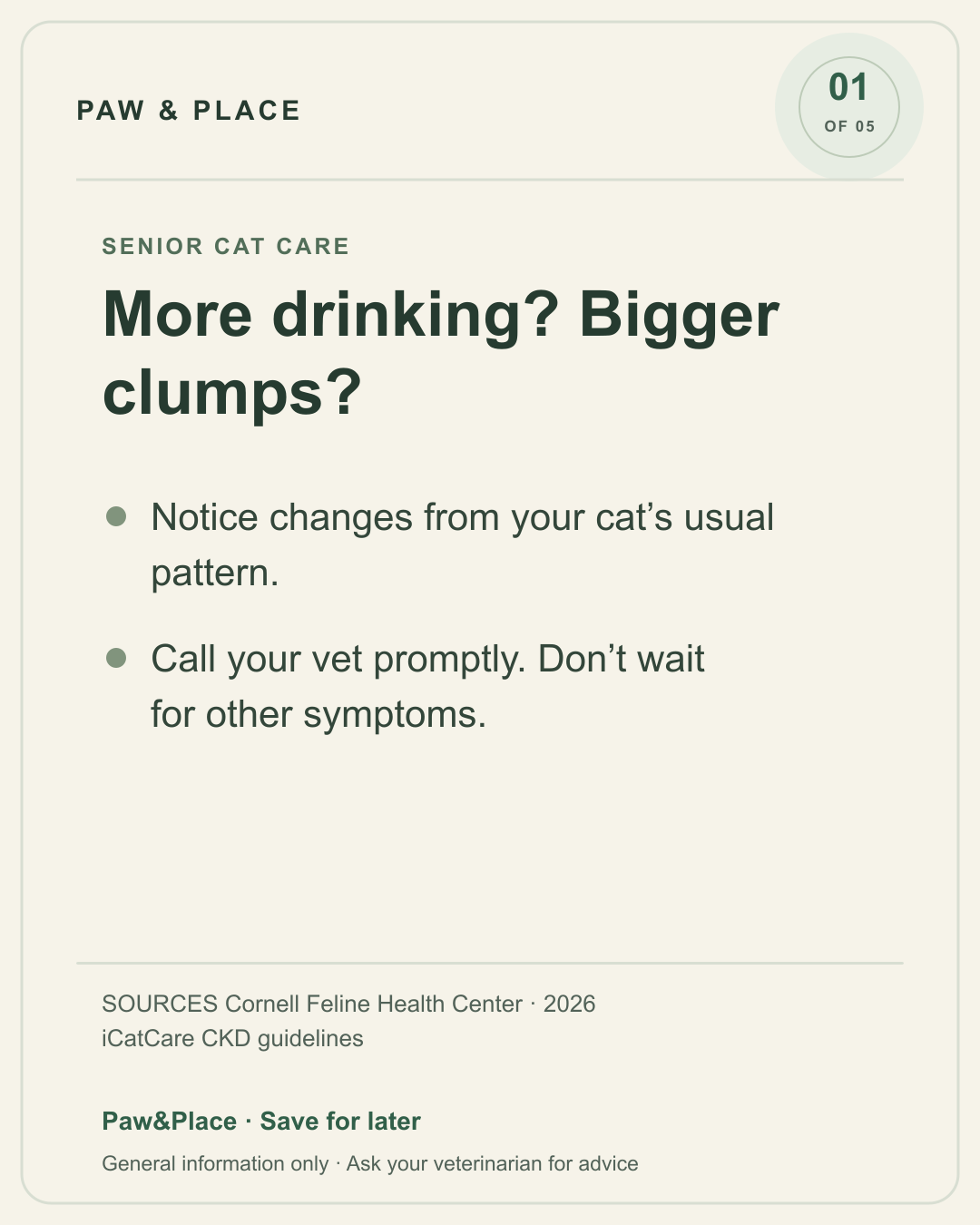
More drinking? Bigger clumps?
- Notice changes from your cat’s usual pattern.
- Call your vet promptly. Don’t wait for other symptoms.
General information only; this is not a diagnosis or treatment plan. Contact a licensed veterinarian about your cat’s health.
Sources: Cornell Feline Health Center · 2026 iCatCare CKD guidelines
Download this card (PNG)Sources: Cornell: Chronic Kidney Disease; 2026 iCatCare CKD guidelines, clinical signs and diagnosis.
How CKD progresses: what the stages can and cannot tell you
Kidney disease does not follow a fixed calendar. Some cats remain stable for years. Others deteriorate more quickly, and a cat with chronic disease can also develop an acute problem on top of it. Vets use the International Renal Interest Society, or IRIS, staging system to help plan care rather than predict an exact timeline.
It helps to understand the two blood markers you may see on the report. Creatinine is affected by muscle mass as well as kidney function. A thin cat can therefore have a deceptively low result. SDMA is another marker that is less affected by muscle loss and can help your vet interpret the picture.
SDMA is not a guarantee of earlier detection in every cat. Neither marker, by itself, confirms the diagnosis or explains every change in kidney function. Trends, hydration, urine results, other illnesses, and sometimes imaging all matter.
IRIS staging is used after CKD has been diagnosed, in a stable, adequately hydrated patient. A sick or dehydrated cat may first need treatment and repeat testing. Blood pressure and urine protein are assessed separately because they also influence care.
| IRIS stage | What it means for the conversation with your vet |
|---|---|
| Stage 1 | There is evidence of kidney disease despite blood filtration markers that may still look relatively normal. The aim is to understand the cause, establish a baseline, and monitor relevant changes. |
| Stage 2 | Kidney function is reduced, but the cat may still seem well. Diet and treatment decisions can help manage the disease before substantial symptoms develop. |
| Stage 3 | Kidney dysfunction is more substantial. Appetite, hydration, nutrition, and complications often need closer attention alongside treatment intended to slow progression. |
| Stage 4 | Kidney dysfunction is severe. Intensive support or palliative care may be appropriate, depending on the cat's condition, response to treatment, and quality of life. |
This table is an explanation of the stages, not a way to diagnose your cat at home. There is no stage you can reliably assign from thirst, litter clumps, or a single blood result. There is also no stage at which every cat has exactly the same symptoms.
Survival figures from studies describe groups of cats, not how long your cat has left. Ask your vet what your cat's current condition, complications, and response to care suggest. Treatment and comfort matter at every stage. Noticing larger clumps is a reason to act, but it cannot tell you whether the disease is early or advanced.
Sources: IRIS: Staging System; IRIS: Current Guidelines; Cornell: Chronic Kidney Disease.
Checking at home: four things you can track yourself
You do not need an elaborate setup. A measuring jug, a suitable scale, and the notes app on your phone are enough to start. What matters most is knowing your cat's usual pattern and noticing a change. Recording should help you communicate with your vet, not delay an appointment while you collect perfect data.
1. Water intake
If you can measure one cat's bowl drinking reliably, record how much water you put out and how much remains 24 hours later, including any refills. Keep all normal water sources available. Spills, evaporation, fountains, and other pets make this only an estimate.
Keep the diet similar when comparing days. Cats eating wet food receive substantial water from meals, so bowl drinking does not equal total water intake. Note the wet-to-dry food ratio, any diet change, and unusually hot weather alongside the measurement.
If several cats share bowls, do not assume the missing water all belongs to the older cat. A note that one cat is visiting the bowl more often may be more useful than an inaccurate number. Ask your vet whether more detailed measurement would help.
A clear increase from your cat's usual drinking is worth reporting. There is no single home-measured cutoff that rules out disease. Never withhold water to measure thirst or reduce urination.
2. Urine clumps
Look at the litter when you scoop each day. Note whether clumps are becoming larger, more numerous, or unusually small. Keep the litter type and depth reasonably consistent if you want to compare photographs over time.
A camera can be useful in a multi-cat household, but it is optional and may not show which clump came from which visit. You can simply write a short note or take a photograph. Give all cats easy access to enough clean boxes; do not force an older cat into a stressful new arrangement just to obtain a measurement.
Repeated trips with straining and little or no urine need immediate attention. Do not treat that pattern as ordinary increased urination or wait for your next weekly review.
3. Body weight
For a cat without a diagnosed condition, a monthly record is a useful habit. Use the same scale and a similar routine. A pet or baby scale that reads small changes is helpful if your cat will use it comfortably.
Weighing yourself while holding the cat and subtracting your own weight can give a rough estimate, but bathroom scales can miss small losses. If you cannot get a reliable reading, ask the clinic about weight checks rather than forcing your cat onto a scale.
Report confirmed, unintended weight loss promptly. Do not wait for two or three months of falling readings. If your cat already has CKD, your vet may recommend weighing more often.
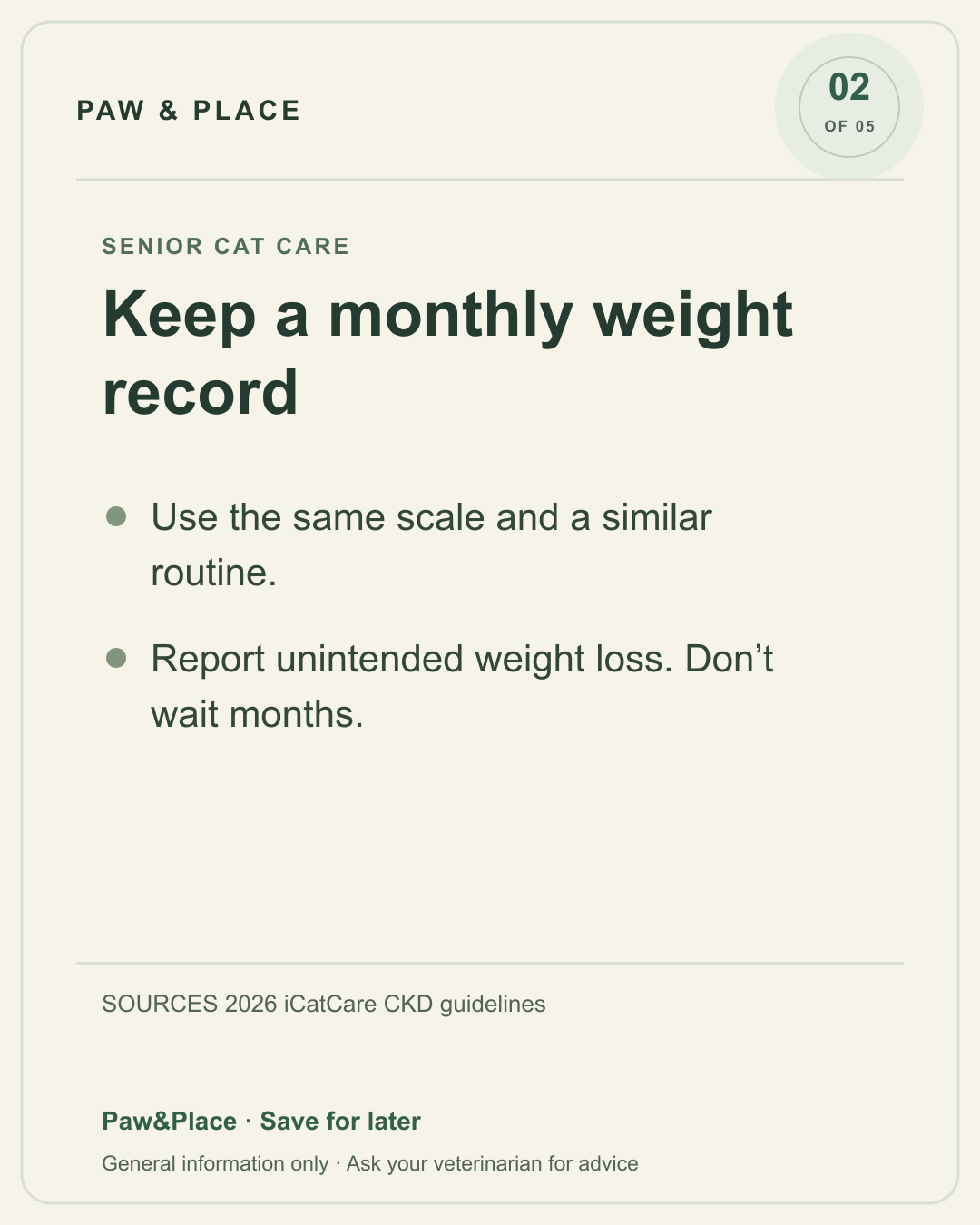
Keep a monthly weight record
- Use the same scale and a similar routine.
- Report unintended weight loss. Don’t wait months.
General information only; this is not a diagnosis or treatment plan. Contact a licensed veterinarian about your cat’s health.
Sources: 2026 iCatCare CKD guidelines
Download this card (PNG)4. Muscle, appetite, and hydration concerns
As you stroke your cat, notice whether the spine, shoulder blades, or hips feel more prominent. Ask your vet to show you how to assess muscle condition so you have a useful reference. Changes in muscle and changes in total body weight are not always the same thing.
Also note what your cat actually eats, not just whether it approaches the bowl. Picking at food, walking away, or eating less than usual can be important changes.
A skin-pinch test is not a reliable home rule-out for dehydration in an older cat: skin elasticity and loss of fat can alter the result. Tacky gums or other concerns deserve a call, but normal-looking skin or gums cannot prove that hydration is adequate. Avoid repeatedly handling the mouth if your cat finds it uncomfortable.
| What to record | A practical starting routine | What to report |
|---|---|---|
| Drinking | Notice daily; measure when useful or requested | A clear increase from the usual pattern |
| Urine | Look while scooping daily | More urine, a persistent change, or straining |
| Weight | Monthly when well; as advised after diagnosis | Confirmed unintended loss |
| Food and behavior | Notice daily | Reduced intake, vomiting, weakness, or a change in normal activities |
Sources: Cornell: Hydration; 2021 AAFP Senior Care Guidelines; 2026 iCatCare CKD guidelines, clinical signs and monitoring.
When to see the vet, and what to ask about
Get emergency help now
- Your cat repeatedly strains to urinate but produces little or no urine. A urinary blockage is an emergency, especially in male cats, and cannot safely wait until later in the day.
- Your cat suddenly seems unable to see. Sudden vision loss can be associated with high blood pressure and needs urgent assessment.
- Your cat collapses, has trouble breathing, or becomes profoundly weak.
- You suspect exposure to a kidney toxin such as a true lily, daylily, or human medication. Do not wait for symptoms.
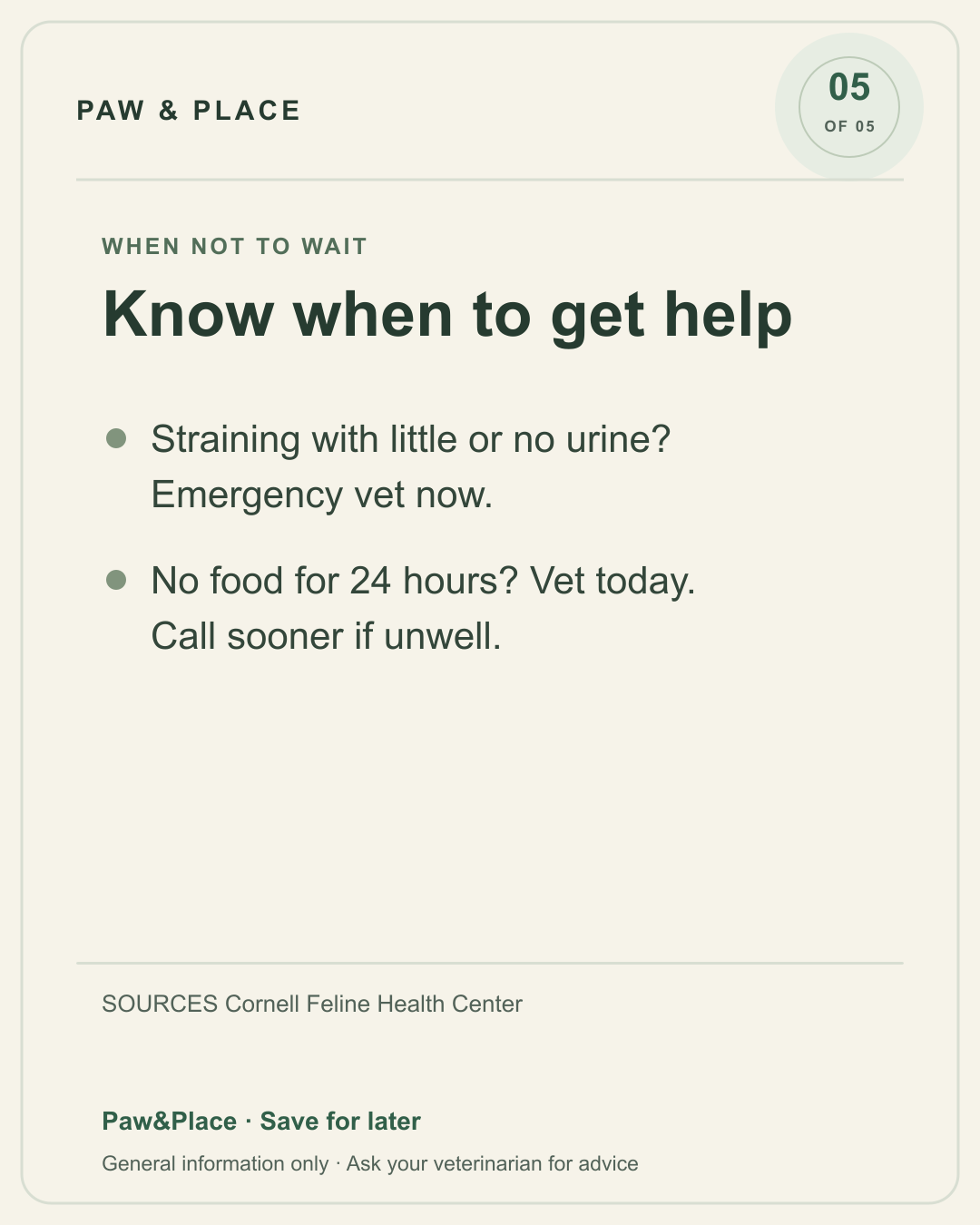
Know when to get help
- Straining with little or no urine? Emergency vet now.
- No food for 24 hours? Vet today. Call sooner if unwell.
General information only; this is not a diagnosis or treatment plan. Contact a licensed veterinarian about your cat’s health.
Sources: Cornell Feline Health Center · Cornell Feline Health Center
Download this card (PNG)Contact your vet for same-day advice
Call if your cat is vomiting repeatedly, eating substantially less, unusually lethargic, or appears dehydrated. If a cat has eaten nothing for 24 hours, seek prompt veterinary care; contact the clinic sooner if the cat is already ill or has other symptoms. The clinic can tell you whether to come straight in or go to an emergency service.
For a new, persistent increase in thirst or urine, or confirmed unintended weight loss, contact the clinic promptly to arrange assessment. Do not automatically wait one or two weeks, particularly if the change is sudden or the cat is otherwise unwell.
Keep routine screening separate from symptom checks
For apparently healthy cats, current iCatCare guidance recommends screening from age seven. Cats aged seven to ten should generally have annual examinations, and cats over ten should preferably have routine checks twice a year. Blood and urine testing help establish trends; your vet should tailor the schedule to your cat's age and health.
If kidney disease is suspected, ask which of these are appropriate:
| Test or assessment | What it contributes |
|---|---|
| Creatinine, urea/BUN, and SDMA | Help assess kidney function in context; creatinine and SDMA inform staging after diagnosis |
| Complete urinalysis, including urine specific gravity | Assesses urine concentration and looks for other abnormalities |
| Urine protein:creatinine ratio, when indicated | Measures protein loss; persistent findings need interpretation after other urinary causes are considered |
| Blood pressure | Checks for hypertension, including the risk of damage to the eyes and other organs |
| Blood count, phosphorus, electrolytes, and calcium | Looks for anemia and abnormalities that can change treatment |
| Thyroid testing | Helps assess hyperthyroidism, which can coexist with or complicate kidney disease |
| Imaging or urine culture, when indicated | Helps investigate structural problems or suspected infection |
Follow the clinic's instructions about food before the visit. Do not withhold water unless your veterinarian specifically instructs you to do so. One abnormal result needs interpretation, not a diagnosis made from an online table. Your vet will decide whether and when repeat samples are needed.
Sources: Cornell: Feline Lower Urinary Tract Disease; Cornell: Anorexia; Cornell: Sudden Blindness; 2026 iCatCare CKD guidelines; FelineVMA: Routine Veterinary Care.
After diagnosis: what actually helps
Established chronic kidney damage generally cannot be reversed, but there is still a lot you can do. The plan should suit the individual cat, including other illnesses, food preferences, and what is manageable at home.
1. A veterinary renal diet, when recommended
Therapeutic kidney diets are among the best-supported treatments for feline CKD. They adjust phosphorus, protein, and other nutrients rather than simply removing protein. They are commonly recommended in stages 2 to 4, with the exact choice guided by your vet.
Make the transition gradually while watching how much your cat eats. Different textures and flavors may help, and gently warming wet food can improve its appeal. Offer food warm, not hot.
Do not let your cat go hungry while trying to force a diet change. If the new food is refused, contact your vet and keep the cat eating an acceptable food while you work out a plan. Nausea, dental pain, or another problem may need attention first. Phosphate binders or other adjustments are prescribed for particular needs; they are not a do-it-yourself substitute for a balanced diet.
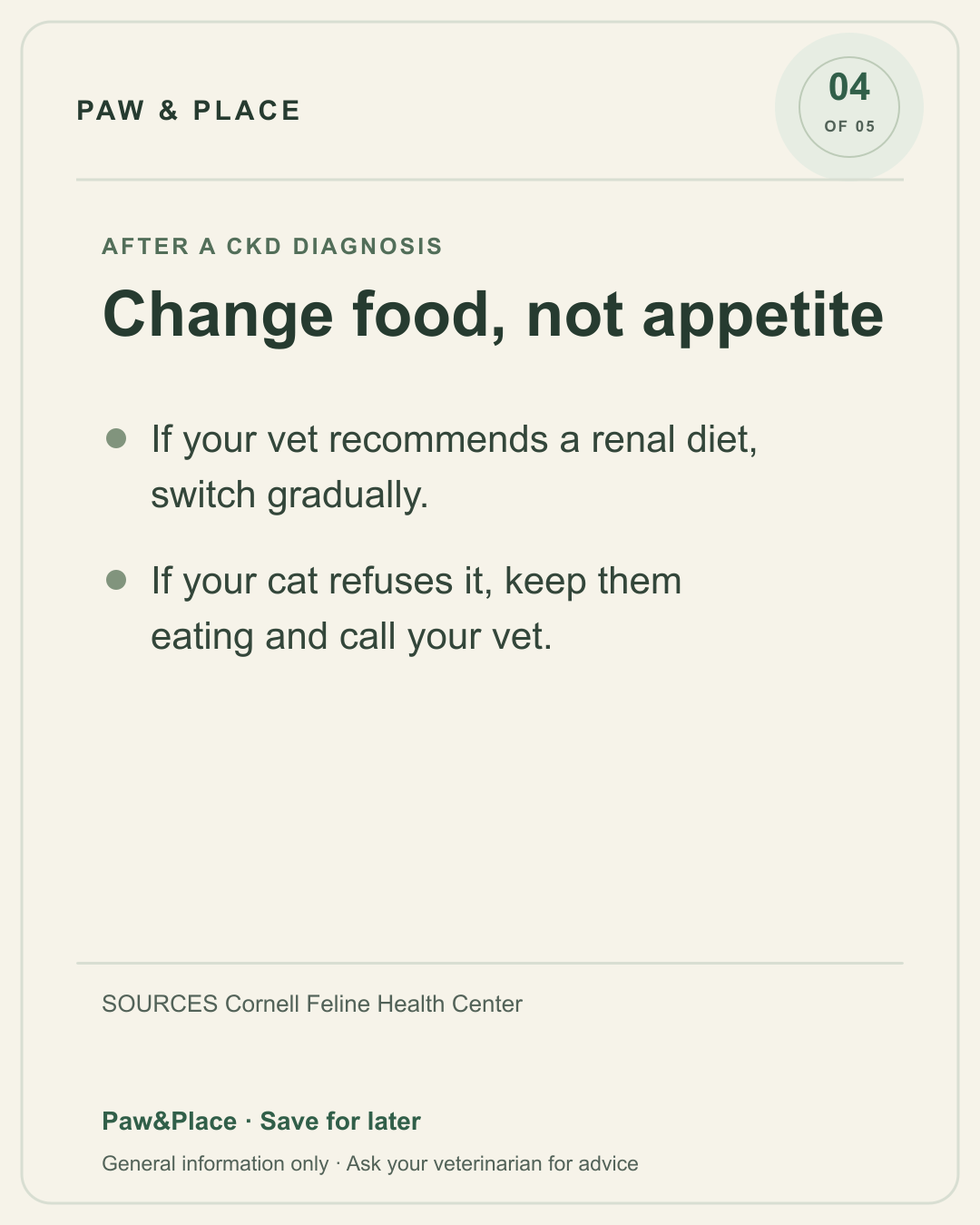
Change food, not appetite
- If your vet recommends a renal diet, switch gradually.
- If your cat refuses it, keep them eating and call your vet.
General information only; this is not a diagnosis or treatment plan. Contact a licensed veterinarian about your cat’s health.
Sources: Cornell Feline Health Center
Download this card (PNG)2. Easy access to water
Cats with CKD can lose a lot of water through their urine. Keep several clean water sources in quiet, accessible places. Some cats prefer a fountain; others prefer an ordinary bowl.
Wet food can help with water intake. A little added water may also be useful if it does not make the food less appealing or reduce the amount eaten. Keep changes gradual and work within your cat's nutrition plan.
Never limit water to cut down on urination. Some cats need fluids given under the skin, but the amount and frequency must be prescribed and reviewed by the veterinary team. More fluid is not automatically better, especially when other health conditions are present.
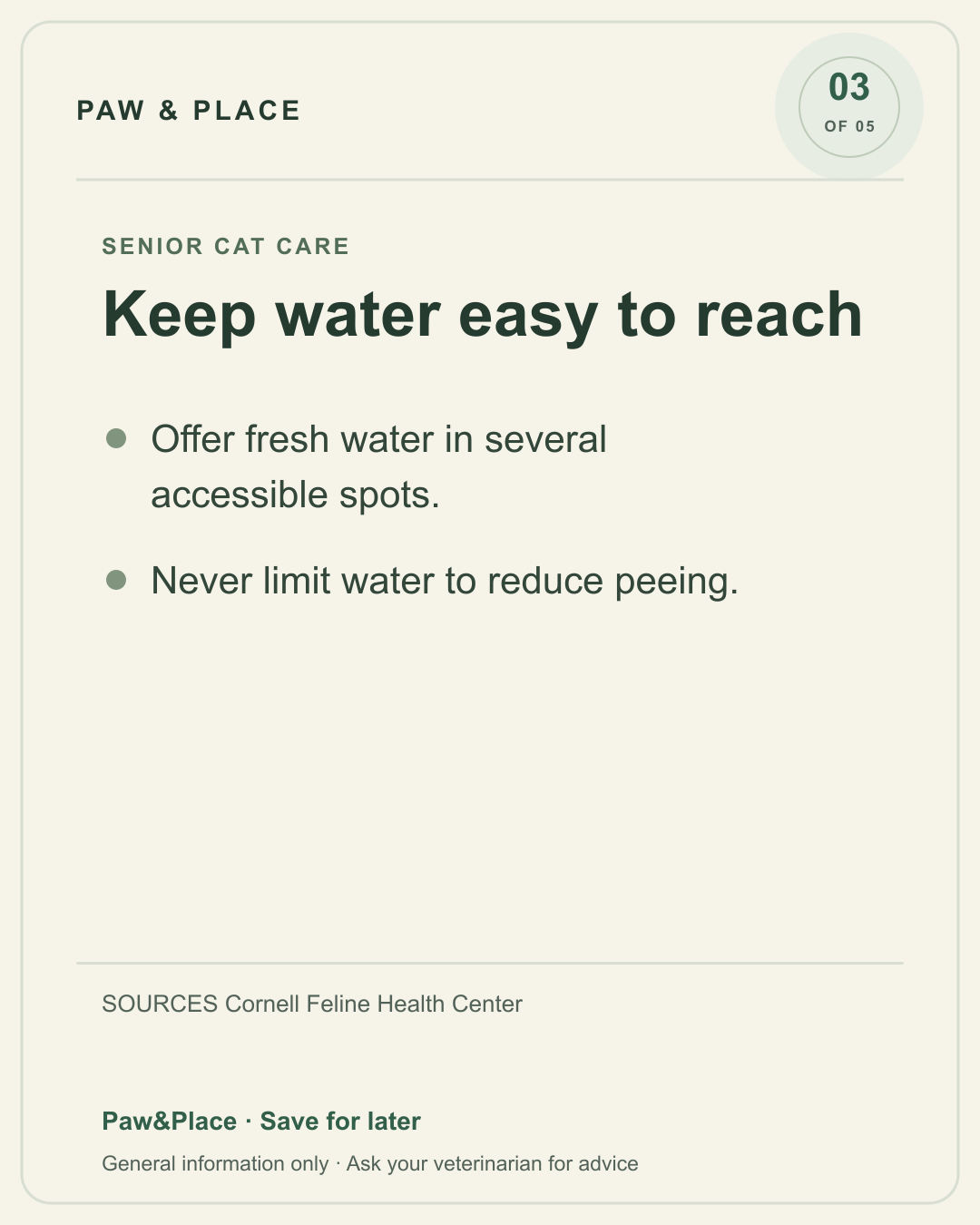
Keep water easy to reach
- Offer fresh water in several accessible spots.
- Never limit water to reduce peeing.
General information only; this is not a diagnosis or treatment plan. Contact a licensed veterinarian about your cat’s health.
Sources: Cornell Feline Health Center
Download this card (PNG)3. Monitoring blood pressure and urine protein
High blood pressure can damage the eyes and other organs. Protein loss in the urine also matters when managing CKD. These are reasons to keep follow-up appointments even when your cat looks comfortable at home.
Treatment decisions depend on reliable measurements, persistent changes, and the whole clinical picture. Do not start, stop, or adjust medication based on a single number copied from an article.
4. Treating nausea and poor appetite
If your cat eats less, walks away from food, or vomits, tell your vet. Medication and nutritional support may help, but the cause should be assessed rather than assuming every symptom is simply the kidneys.
A short record of meals offered, amounts eaten, vomiting, and weight is useful. Bring a list of all medications and supplements too. This helps the team decide what is working and what might need to change.
5. Being selective about supplements
A product labeled "kidney support" is not automatically effective or suitable for your cat. Ask what problem it is intended to treat, what evidence supports it, and whether it could interfere with food or medication. Do not replace prescribed care with an unproven supplement.
Recheck timing depends on stability and treatment. The interval may be shorter after diagnosis, a medication change, or deterioration. Once the cat is stable, visits every three to six months may be suitable. Your vet should set the schedule and tell you which changes warrant an earlier call.
Sources: IRIS: Current Treatment Guidelines; Cornell: Chronic Kidney Disease; 2026 iCatCare CKD guidelines, management and monitoring.
What you can do while your cat is still young
There is no proven way to prevent all CKD. Age is an important risk factor, and some cats develop kidney disease for reasons an owner could not have prevented. Useful habits can still support health and make changes easier to recognize.
Keep a baseline. Save your cat's weights and veterinary test results. Comparing an individual cat's results over time can be more informative than looking only at whether today's value sits inside a reference range. Ask your vet when baseline blood and urine testing makes sense.
Make drinking and eating comfortably part of daily life. Provide fresh water and a nutritionally complete diet. Wet food can be one option if it suits your cat. These habits support hydration; they should not be presented as a guarantee against CKD.
Look after the teeth. Introduce cat-safe toothbrushing gradually and arrange dental care as advised. Dental disease and CKD have been associated in studies, but that does not prove brushing prevents kidney disease. Good oral care has benefits of its own.
Track weight before there is a problem. A regular record makes small losses easier to spot. If a young or older cat loses weight unintentionally, investigate rather than waiting for another symptom.
Keep kidney toxins out of reach. True lilies and daylilies can cause fatal kidney injury in cats, including through pollen or vase water. Keep them out of a cat household. Store medicines securely and never give human medication without veterinary direction. If exposure may have happened, contact a vet immediately rather than waiting to see how the cat feels.
Sources: 2026 iCatCare CKD guidelines, risk factors and screening; FDA: Lovely Lilies and Curious Cats; FDA: Potentially Dangerous Items for Your Pet.
Kidney disease and pain can both show up as eating less, hiding or sleeping more. If you are unsure what you are seeing, our free Cat Pain Check helps you note facial and behaviour changes for your vet. It is not a diagnosis.
Frequently asked questions
Can chronic kidney disease in cats be cured?
There is no routine cure for established CKD. Management aims to slow progression, treat complications, and maintain quality of life. Some cats remain well for years; others need much more support. Your cat's response to care matters more than a population average.
Does drinking a lot always mean kidney disease?
No. Changes in diet or weather can affect drinking, and several illnesses can cause increased thirst. Blood and urine testing, together with an examination, help identify the reason. Do not assume a cat is fine simply because the bowl measurement is below a particular number.
At what age should my cat have its kidneys checked?
Discuss screening from age seven, and earlier if there are symptoms or individual risk factors. Routine checks generally become more frequent after age ten. New symptoms should be assessed when they appear, not saved for the next scheduled wellness visit.
Should I switch my older cat to a low-protein diet just in case?
Not without veterinary advice. An older cat still needs adequate nutrition to maintain muscle and body condition. A therapeutic renal diet is a treatment decision, not a default food for every cat who has reached a particular birthday.
My cat is in stage 4. What can I still do?
Ask your vet about nausea, nutrition, hydration, anemia, blood pressure, and any reversible problem making your cat worse. Discuss comfort and quality of life openly, including what changes would mean treatment is no longer helping enough. Stage 4 is serious, but a stage number alone should not make the decisions for you.
Sources: Cornell: Chronic Kidney Disease; IRIS: Current Guidelines.
References
- Taylor S, Finch N, Caney S, et al. 2026 iCatCare consensus guidelines on the diagnosis and management of chronic kidney disease in cats. Journal of Feline Medicine and Surgery. 2026;28(9). DOI: 10.1177/1098612X261466553.
- International Renal Interest Society. IRIS Guidelines, including the 2026 staging and treatment revisions, and Overview of the IRIS Staging System.
- Cornell Feline Health Center. Chronic Kidney Disease. Updated January 2025.
- Ray M, Carney HC, Boynton B, et al. 2021 AAFP Feline Senior Care Guidelines. Journal of Feline Medicine and Surgery. 2021.
- Cornell Feline Health Center. Hydration.
- Cornell Feline Health Center. Feline Lower Urinary Tract Disease.
- Cornell Feline Health Center. Anorexia.
- Feline Veterinary Medical Association / Cat Friendly Homes. Importance of Routine Veterinary Care for Your Cat.
- U.S. Food and Drug Administration. Lovely Lilies and Curious Cats: A Dangerous Combination.
- Cornell Feline Health Center. Sudden Blindness.
- U.S. Food and Drug Administration. Potentially Dangerous Items for Your Pet.
This article is for general information and does not replace veterinary diagnosis or treatment. If your cat's health or behavior changes, contact a licensed veterinarian. If your cat may be unable to pass urine, seek emergency veterinary care immediately.